
Summary
- Banking automation is the use of software to take repetitive work off people’s desks, from onboarding checks and loan processing to payments, reconciliations, and reporting.
- Manual back-office processes hold up well at small scale. They fail when growth accelerates, and operations become the limit on how fast a bank can grow.
- Scalable banking automation starts with the highest-volume workflows, builds data validation into every integration, and matches the tool to the job.
- At UK small business bank Allica Bank, TEAM International engineers automated 95% of internal back-office processes, helping Allica scale quickly through 2023 and 2024.
- The most useful measure of success is growth capacity: how much more volume a bank handles without adding headcount at the same pace.
Manual back-office processes are surprisingly durable. A small operations team handles onboarding checks, loan paperwork, and reconciliations by hand, and it works. When volume doubles, the bank needs to hire more people. It still works, mostly.
Then growth accelerates. Deals wait in a queue for manual review. Exceptions live in email threads and spreadsheets. Product and sales are ready for the next market, and operations quietly becomes the reason the bank can't get there. That ceiling is what banking automation is meant to remove, and Allica Bank hit it while becoming the fastest-growing fintech in the history of Deloitte's UK Technology Fast 50.
When volume outruns the back office
Manual work scales with headcount. Every new customer, loan, or payment adds a fixed amount of human effort, so costs climb in a straight line while growth targets curve upward. The gap stays small for a long time, which is exactly why it goes unnoticed.
Banks are aware of the opportunity. In the Bank of England and FCA survey of UK firms, 75 percent already use AI. Optimizing internal processes is the most common use, cited by 41 percent of respondents. Interest in financial services automation is high. Turning it into everyday capacity is the harder part.
It’s clear that banks are spending more on technology than other sectors, yet their productivity still lags. Their gains get lost between the budget and the day-to-day operations.
Signs your back office is the bottleneck
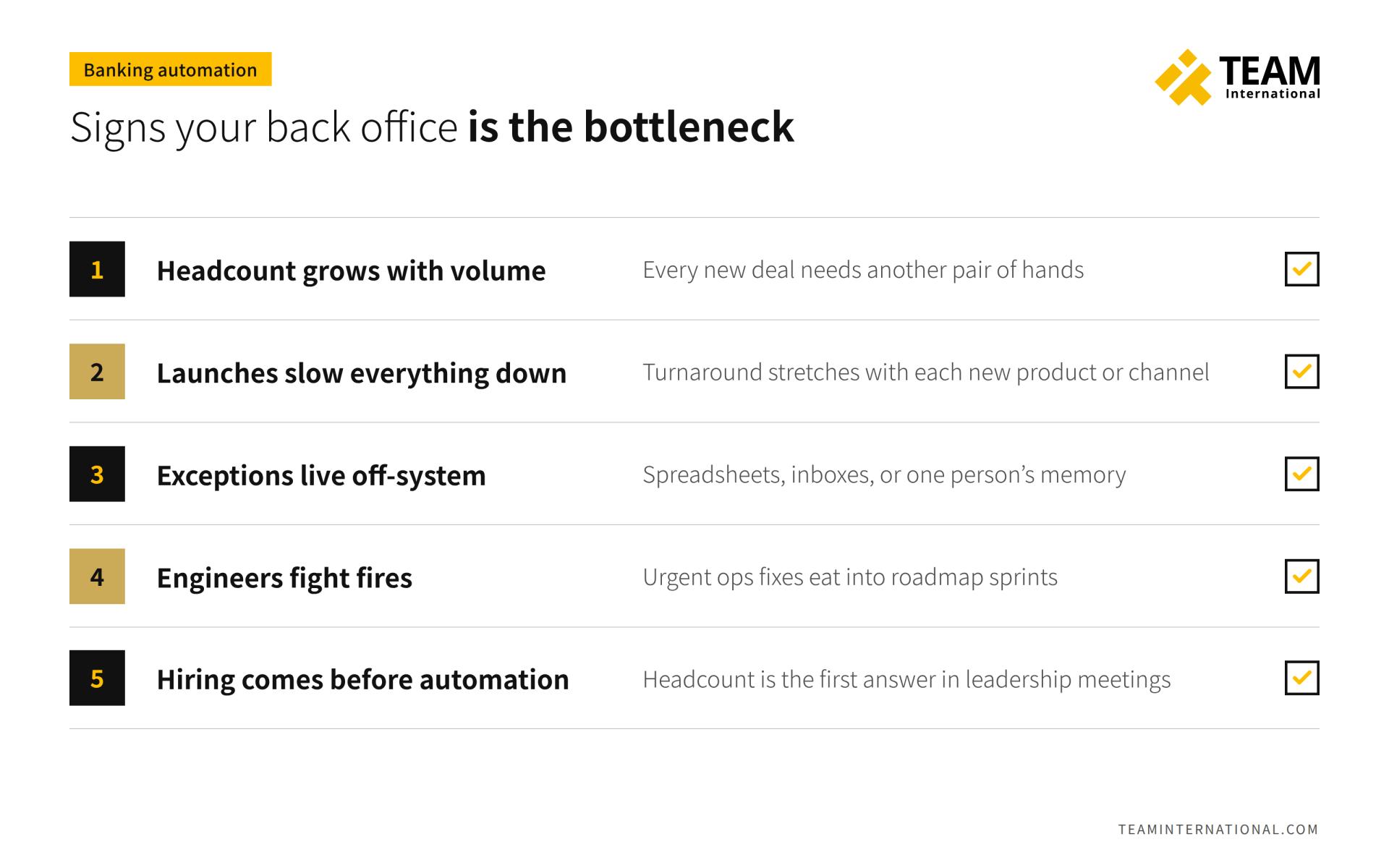
Operations leaders usually feel the pressure first. They own the queues, the service levels, and the audit trail, so they notice when each new deal takes a little longer than the last. Watch for these signals:
- Operations headcount grows at the same rate as transaction volume
- Turnaround times stretch every time a new product or channel launches
- Exceptions are tracked in spreadsheets, inboxes, or one person's memory
- Engineers spend sprints on urgent operational fixes instead of the roadmap
- Hiring plans come up in leadership meetings before automation does
But by the time the delay shows up in revenue reports, the fix is already overdue.
What scalable banking automation requires
Scaling is where most programs stall. McKinsey's State of AI 2025 found that 88 percent of organizations use AI in at least one function, yet only about a third have begun scaling it. Gartner expects more than 40 percent of agentic AI projects to be canceled by the end of 2027, citing rising costs, unclear value, and weak risk controls.
Banking automation that holds up in production tends to follow three principles:
Start with the highest-volume work
Edge cases are tempting targets because they are painful. Capacity, however, lives in volume. Automate the workflows that run hundreds of times a week: data entry between systems, document checks, status updates, and handoffs. Leave rare exceptions to people until the core flow is stable.
Match the tool to the job
Robotic process automation (RPA) in banking works well for stable, rules-based tasks on screens that rarely change. Intelligent automation in banking adds machine learning or document understanding for work that needs judgment. When a process sits at the heart of how the bank grows, it often belongs inside the platform itself.
| Approach | Best for | Watch out for |
|---|---|---|
| RPA | Repetitive, rules-based tasks across existing screens | Bots break when interfaces change, and upkeep grows with every bot |
| Intelligent automation | Unstructured data and judgment calls, like document review | Needs clean data and human review for edge cases |
| Automation built into the platform | Core, high-volume flows like lending and onboarding | Requires engineering capacity and a modular architecture |
Many banks combine all three. The right banking automation solutions depend on how central each process is to growth, and how long the business will rely on it.
Build data validation in from day one
Every third-party integration is a point where bad data can enter: credit bureaus, payment providers, and identity checks among them. Automated validation at those points catches errors before they reach a customer or a regulator. Adding checks later means auditing months of data that already moved through the system.
Inside Allica Bank's automation build
Allica Bank launched in 2019 to serve established UK small and medium-sized businesses (SMEs). By 2023, it topped Deloitte's UK Technology Fast 50 with four-year revenue growth of 85,438 percent, and it held more than £2 billion in deposits. Growth at that pace puts every manual process under strain.
Allica's CEO, Richard Davies, summed up the bank's approach to Deloitte: "We are about people and data. So we are building unique, proprietary software to solve these customers' needs at scale." So their back-office automation had to follow the same logic.
Engineers inside the squads
From the TEAM International side, we embedded 10–20 engineers across several of Allica's squads. Our team covered back-end, front-end, and mobile development, as well as UX/UI design. Our engineers took key roles in each squad and joined product planning sessions, so automation decisions were made alongside product decisions.
The team built the banking automation software as microservices on Microsoft Azure, using Kotlin and Spring Boot. It introduced code reviews and unit tests, and covered key third-party integrations with automated data validation. Scrum gave every squad the same delivery rhythm, and engineers traveled onsite to align with Allica's local teams.
95% of internal processes automated
TEAM's engineers automated 95 percent of Allica's internal back-office processes. Task-heavy operations that once took far longer now run in seconds or minutes. Turnaround times dropped, the lending cycle sped up, and Allica could close more deals with new clients.
The freed-up capacity went back into the business. Staff moved from repetitive processing to higher-value work, and Allica kept shipping new features on tight deadlines. That combination helped the bank scale quickly through 2023 and 2024. Earlier, in 2022, Allica's payments team won Top Tech Team UK, Bank/Financial Institution at the Banking Tech Awards for a payments solution built jointly with TEAM engineers.
Where to start in your back office
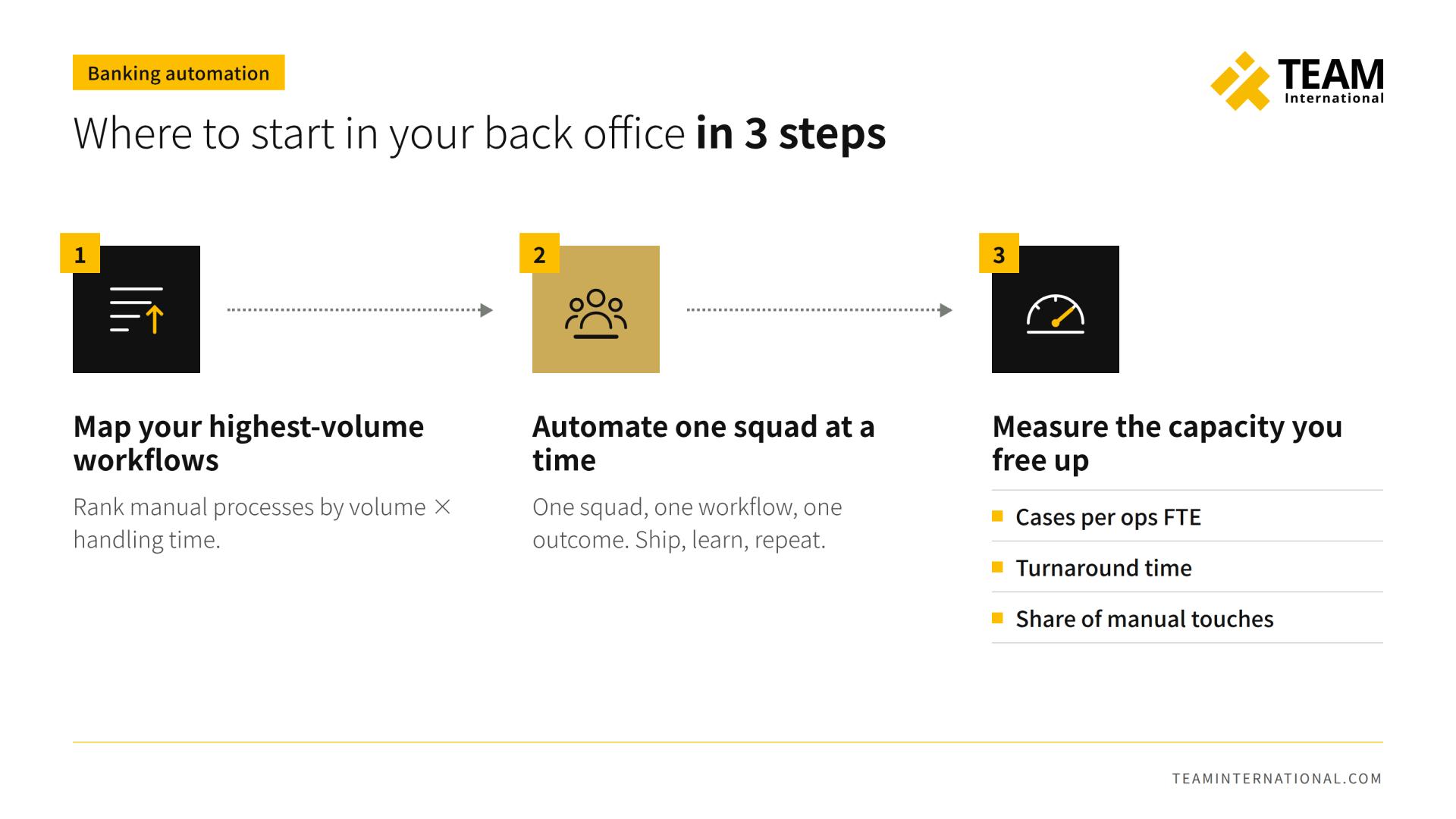
You don't need a full rebuild to make progress in the finance and banking industry. These three steps give operations leaders a practical starting point.
Map your highest-volume workflows
List every manual process with its weekly volume, average handling time, and error rate. Multiply volume by handling time to see where the hours actually go. Rank the list from the top, even if the most visible problem sits further down.
Automate one squad at a time
Big-bang rollouts put every process at risk at once. Pick one squad, one workflow, and one measurable outcome. Ship it to production, learn from it, and move to the next. This rhythm keeps risk contained while results add up, and it applies to RPA in financial services as much as to custom builds.
Measure the capacity you free up
Hours saved is a useful first metric. Growth capacity tells you more: how much additional volume your team handles without adding people at the same rate. Track these three numbers before and after each release:
- Deals or cases handled per operations full-time employee (FTE)
- End-to-end turnaround time
- Share of work that still needs a manual touch
Clear the way for growth
Back-office automation rarely makes headlines, yet it decides how fast a bank can grow. Allica's experience shows what happens when automation is built into the platform, validated from day one, and rolled out squad by squad.
If manual work is starting to set the pace for your bank, our intelligent automation solutions can help you find the right place to start. Let's talk.