
Most legal technology doesn't fail loudly. A case management system that's been fine for years keeps working right up until a marketing push, a surge in claimants, or a new piece of litigation asks it to do ten times more than it was built for. Then it doesn't slow down. It just stops.
That's what one of our customers, a group litigation firm, was staring down ahead of a major public campaign expected to bring in roughly 100,000 new claims. By the time the campaign ended, the platform had processed 153,072, from the moment a claimant opened the site to the moment they received confirmation, with zero downtime. What made that possible is a story about legal workflow automation. Discover how we made that success possible.
The growth ceiling legal tech firms don't see until it's too late
Most legal operations teams don't think of their case management stack as having a ceiling. It handles intake, tracks matters, and routes documents. It works, right up until volume changes shape. For a director of legal operations, a managing partner, or a chief operating officer (COO), that's a reputational problem as much as a technical one.
Claimants who hit an error message, a stalled form, or an unclear confirmation rarely try again, and in group litigation, where firms are actively racing to sign up every affected party they can reach, a failed submission is a person who may never be represented at all.
This is the pattern behind most legal tech failures at scale: they aren't sudden, and they're structural. Systems built for one caseload quietly cap what the firm can take on next, and that ceiling stays invisible until something forces it into the open.
The pressure isn't unique to a single firm or one campaign. In the U.S. alone, federal courts had 205,540 pending actions across 162 active multidistrict litigation dockets as of August 2026, up from 197,115 just ten months earlier, and the number keeps climbing, according to the Judicial Panel on Multidistrict Litigation. This is a reminder that mass litigation volume tends to move in one direction, regardless of which jurisdiction a firm operates in.
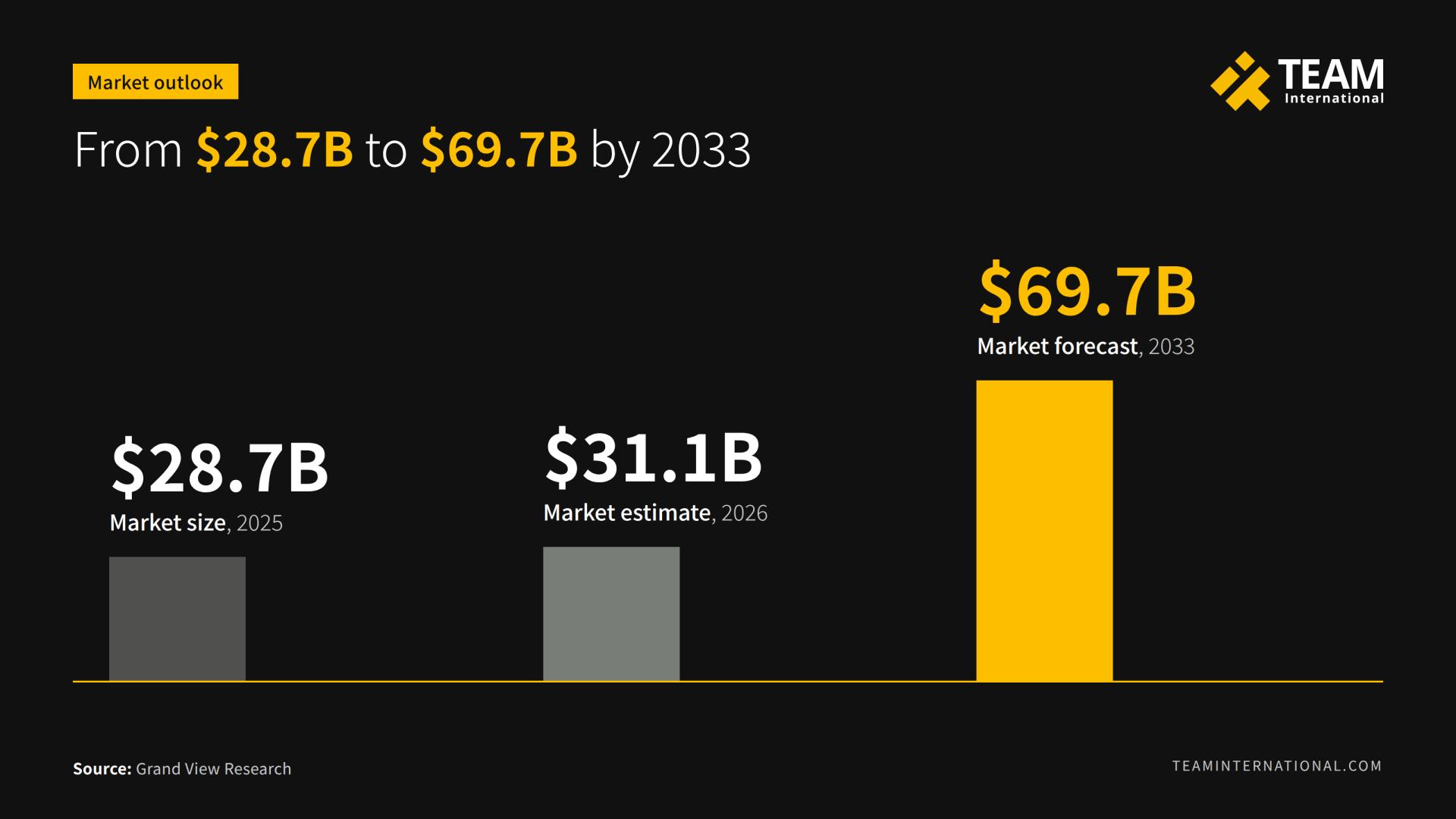
For the litigation platform behind our customer numbers, that ceiling showed up ahead of the campaign itself. Early performance testing made clear that the legacy system wouldn't hold up to the expected volume, let alone the surge that eventually arrived. Rather than treating it as a crisis, the team treated it as information: a specific, fixable gap in the firm's litigation case management infrastructure, caught before it became public.
What legal workflow automation actually requires at scale
Fixing this kind of problem rarely means ripping out and replacing the firm's core claims management software. Most firms can't afford that disruption, and most don't need to. What legal workflow automation actually requires is a layer of orchestration built around the existing system, one that absorbs volume before it ever reaches the parts of the stack that weren't designed to handle it.
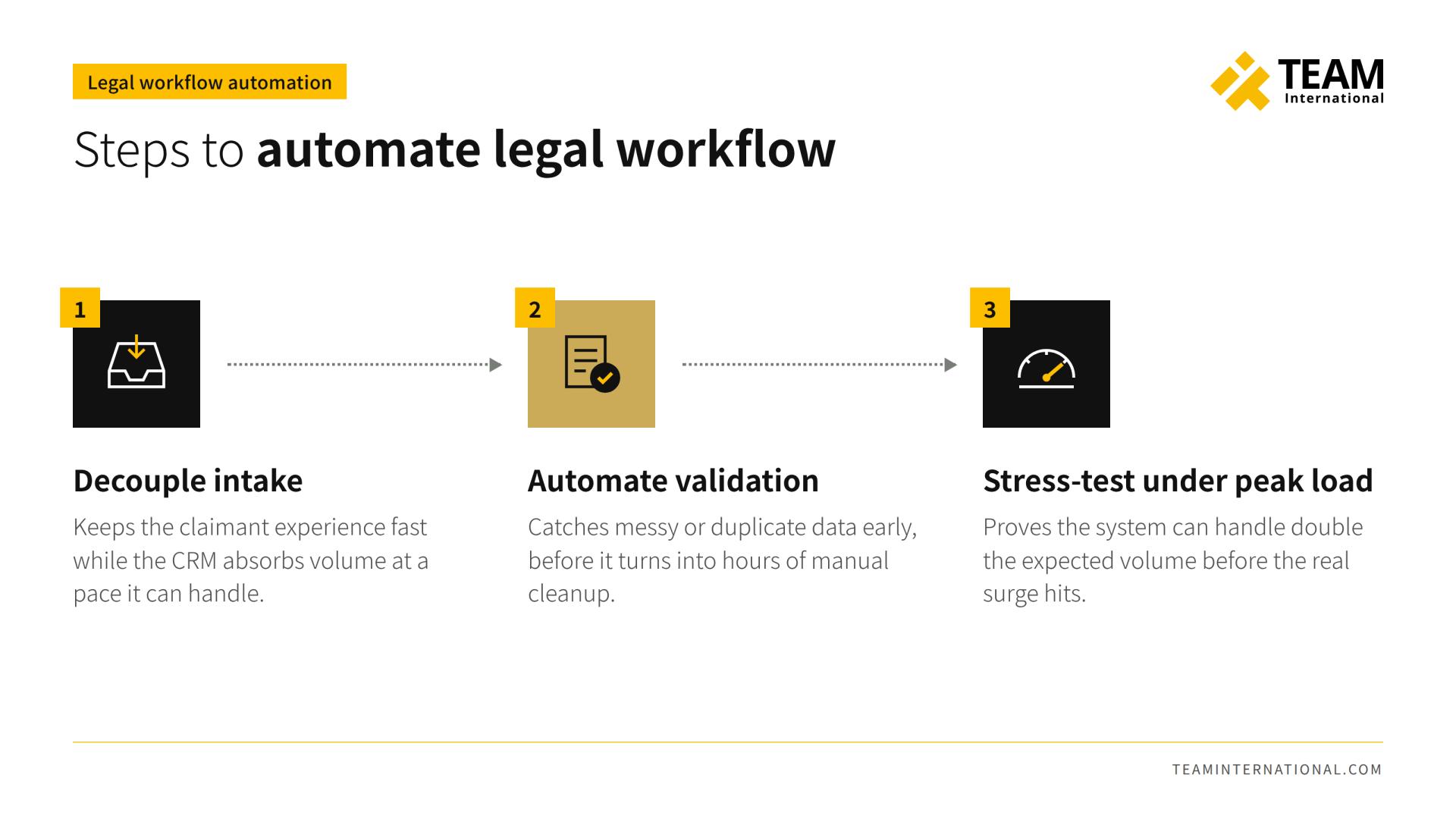
Decouple intake from core case management
The first move is separating the moment a claimant submits information from the moment that information lands in the firm's customer relationship management (CRM) system or legal case management platform.
Rather than sending every submission directly into the core platform, an automated queue sits between the online form and the downstream system, holding submissions and releasing them in a steady, manageable flow. This alone is often what turns a legal intake software failure into a non-event. The claimant-facing side stays fast and responsive no matter how many people arrive at once, while the CRM receives a pace of data it can actually process without falling over. It's the same principle behind law firm workflow management done well: separate what must be instant (the claimant's experience) from what must be careful (the firm's system of record).
Automate data validation before it multiplies manual work
Mass intake generates messy data by default, duplicate entries, incomplete fields, and inconsistent formatting. Left unaddressed, that mess results in hours of manual cleanup for paralegals and case managers before a single claim can move forward.
Automating validation and cleansing at the point of intake and integrating with external sources to verify claimant data as it arrives dramatically reduces downstream work. This is where a modular approach to data engineering services pays off: automated pipelines and API-driven checks catch problems early, so legal ops teams can spend their time on case strategy rather than chasing down bad data in claims-processing software.
Stress-test under simulated peak load before the real surge hits
None of this matters if it isn't proven under pressure before the pressure is real. The platform behind the 153,000+ claims above was stress-tested against simulated peak load well before the campaign launched, including scenarios built for double the expected volume in case the highest-traffic moment ran even hotter than planned.
That testing showed the queuing architecture, built on Digital Software Studio's Amazon Web Services (AWS) and Java implementation, could sustain 60 signups per second without losing a single record. Firms that skip this step find out whether their legal operations platform can scale in front of their claimants instead of in a test environment, and by then, it's too late to fix quietly.
The next steps for your firm
Legacy systems don't announce their limits — they just hit them, usually at the worst possible moment. That's why law firm intake software deserves to be treated as a growth investment, not a maintenance line item.
The firms handling the largest, highest-stakes campaigns share one habit: they test their capacity to absorb double, five times, or ten times their expected volume long before a real trigger event forces the question. Legal workflow automation, done this way, means a firm's existing law firm automation strategy gets stress-tested and proven before the moment it matters most.
Curious what a queuing layer, automated validation, or a Salesforce integration built for peak load could look like for your firm? Let's talk about what your platform needs to handle your goals.